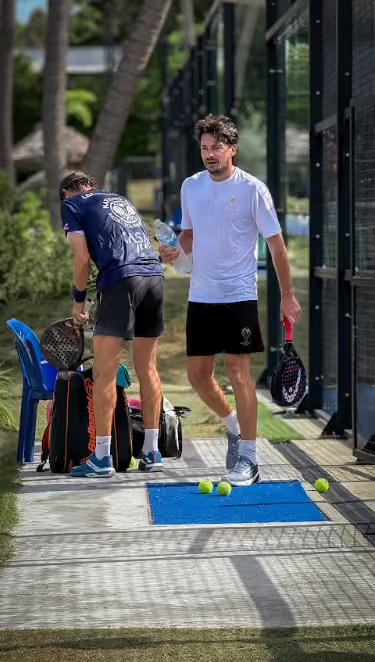
You've watched them plateau. Same errors, same positioning, season after season. A week changes what a year of lessons cannot — and you get paid for sending them, without giving up a single player.
You develop a player for two years. He improves, he gets ambitious, and then one day he books a padel trip he found on Instagram — with someone else, with a coach he's never met, and you hear about it when he comes back.
You built that ambition. You captured none of it.
That's the gap this programme closes. When your players travel to improve, they travel through you, they come back to you, and you're paid on it.
The cap is the product. Level-matched groups, personal correction on every session.
Flights and hotel are theirs to choose. No hidden package, no upsell.
Five to eight days depending on the camp. They live it together — train, recover, eat together.
Islands and destination cities on purpose. Only genuinely committed players get on a plane, and that self-selection is what makes the group.
One coaching voice across every camp. That consistency is what makes the method transferable.
The whole week is built around the errors that actually decide amateur points, not around the shots that look best.
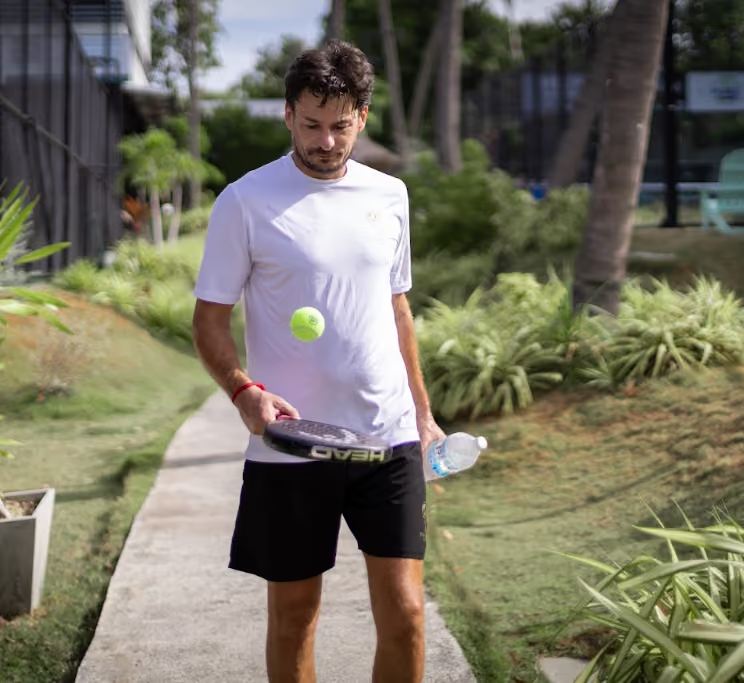
Adult players don't lose to a missing smash. They lose to unforced errors and to standing in the wrong place. You already know this — the hard part has never been diagnosing it, it's getting a player to feel it in a way that changes what he does on Saturday.
The Palaestra Method™ is four pillars, run across the whole camp, built to make that lesson land through repetition under real pressure rather than through explanation.
The shots that decide amateur points — volley, bandeja, playing off the wall — rebuilt to be repeatable rather than spectacular.
He comes back making fewer free mistakes.
How a point is built and won: court position, moving as a pair, forcing the opponent into the risky shot instead of taking it yourself.
He comes back reading the point one shot earlier.
Everything above, tested in live play against players at his level, until it holds when the score is tight and not only in the drill.
He comes back keeping his game under stress.
Video, review and a written read on where he actually stands — so the week produces a plan and not just a good memory.
He comes back to you knowing what to work on.
In a one-hour lesson you tell a player what's wrong. Over a camp he tests it, fails, adjusts and applies it — in front of players at his level. You can't reproduce that in one-hour blocks, and it's why his level moves after a camp and not after a season.

We're building this in three chapters, in order. We're at the start of the first one, and we'd rather tell you that than pretend otherwise.
You bring players. You get paid per seat, transparently, with rules written down before you sign anything. No selling, no inventory, no upfront cost, no monthly quota. Right now this is a small programme with a handful of coaches and a limited number of camps a year — and we'd rather have twelve coaches who actually sell than three hundred names on a list.
They knew Palaestra before there was a programme.
I sent three of my own students on a Palaestra experience. They were looking for something performance-focused, and after talking to the team I understood they would actually progress. They came back making at least fifty percent fewer errors — they build far longer rallies now, and they play to win the net. It was impressive, and it gives us a real base to work from as coaches.
Vincent · Coach, Kuala Lumpur
The method is very well judged. Florent is entirely focused on making players understand the game, not just hit the ball better. Day to day we work on technique; a full week, with the time to actually talk to players, allows something far more personal. By the end of the week the difference is obvious.
Carlos · Coach, Bali
Florent films, and he knows exactly what to film — players get corrected live, on court, in the moment. That unlocks a lot. His passion for the game is contagious, and he gives players a great deal of his time. For him, coaches are the cornerstone of Palaestra, and you feel it.
Luis · Coach, Singapore
A padel coach is structurally alone. You teach the same corrections in your own club, with no peers to compare notes with, no one to tell you whether your progression model holds up. We intend to build the room where those coaches meet — across Singapore, the Gulf, Southeast Asia and Europe. Shared material, real exchange between people who do the same job in different markets, and a direct line to how we build the method.
We're not pretending that room exists yet. Early coaches shape what it becomes.
Coach gatherings on camp destinations. Access to dates before they go public. A method you can take home and use in your own club on Monday morning.
Because here is the thing we actually believe: a training method doesn't spread from a founder. It spreads from the coaches who use it, in their own clubs, with their own players, week after week.
That is what makes coaches the cornerstone of the Palaestra method — not the delivery on camp, which stays ours, but the diffusion, which can only be yours.
Same grid for everyone. It's progressive across the calendar year, and each rate applies to the seats in its own band — it's never retroactive.
Any booking made 45 days or less before a camp that's still under half full pays 12%, whatever band you're in.
A full camp seat, worth €2,500, for you to award as a prize at one of your club tournaments or challenges. We place it on a camp with availability and supply the visuals. One per coach per year, not convertible to cash, and not for your own use.
For any testimonial we actually use in Palaestra promotion. Up to three a year.
Paid in two halves: 50% when the booking is paid, 50% when the camp starts. Bank transfer or Wise. Minimum €25 — below that it rolls over to the next payout. If a booking is refunded, the commission is clawed back.
You're independent. We withhold nothing and you handle your own tax where you live.
An active coach places two to three seats a year — €400 to €600. A coach who really works his base gets to around twelve seats: €3,000 plus a seat to award. We sell nine seats per camp and run a limited number of camps a year, so we're not going to quote you a monthly income. You'd be right not to trust anyone who does.
Five minutes. We're looking for evidence you reach real players, not follower counts.
Direct with the founder. We'll work out whether your base fits, and you'll get straight answers on anything the page doesn't cover.
You pick a camp and we agree how your players tell us you sent them. We walk you through the rules before you sign anything.
They go through the same assessment as everyone else. When they pay, you're paid.
Written here, in public, before you sign — because this is where programmes like this fall apart, and we'd rather you know the rules than discover them in a dispute.

No. The coaching is Florent's — that's the product, and one consistent coaching voice across every camp is what makes the method work. Your side is the referral, and you're paid on it without carrying any of the delivery.
It's one week. They come back playing better and more invested than when they left, and you were paid for it. The coaches who lose players to camps are the ones whose players book without them — and without the commission.
No, and there's no room on it at any level. What you can have is early access to dates before they go public, and a seat to award once you reach ten.
It's a referral programme with one rate card, published above. There's no recruitment of other coaches, no commission on anyone else's sales, no tiers to buy into, and nothing to pay us — ever. If we ever ask you for money, something has gone wrong.
If the booking is refunded, the commission goes back. That's why we pay in two halves — one when he pays, one when the camp starts.
You're independent, we withhold nothing, and you handle it where you live. The agreement spells it out. If you have a specific question we'll come back to you in writing rather than improvise.
Ten to twelve to start, in Singapore and the UAE. The limit isn't how many coaches we can sign — it's how many camps we can run. A coach with nothing to sell disengages, so we'd rather stay under-recruited.
Three camps open, and Bali is down to five seats. Pick one on the call, and tell us which three players you'll talk to that week.
Apply as a coachFive minutes. If it's not a fit, we'll tell you on the call rather than leave you hanging.
Five minutes. Two questions do most of the work — answer them properly and skip the polish.
This page describes the programme; it is not an offer and it is not a contract. Only the signed agreement governs, and the programme may change with reasonable notice.
Coaches in this programme are independent. There is no employment relationship, no subordination, no exclusivity, no quota and no set hours, and you remain free to work with anyone you choose. You refer players; you have no authority to represent Palaestra, to negotiate, or to commit us to anything.
We make no income guarantee of any kind. The figures above are the rate card and honest ranges, not a promise of earnings. Commission is payable only under the attribution rules set out above.
This is not a multi-level or pyramid scheme: there is one published rate card, no commission on anyone else's sales, no recruitment of other coaches, nothing to purchase, and no payment is ever required from you.
The awarded seat is a competition prize placed and supplied by Palaestra and awarded on merit at a tournament or challenge you run. No purchase or payment of any kind is required to enter or to receive it, and it is not awarded by chance.
Palaestra is operated by AFCCP OÜ. The Palaestra Method™ is a trade mark of AFCCP OÜ. Applicant details are processed to review your application — see the privacy policy for how they are held and for your rights.